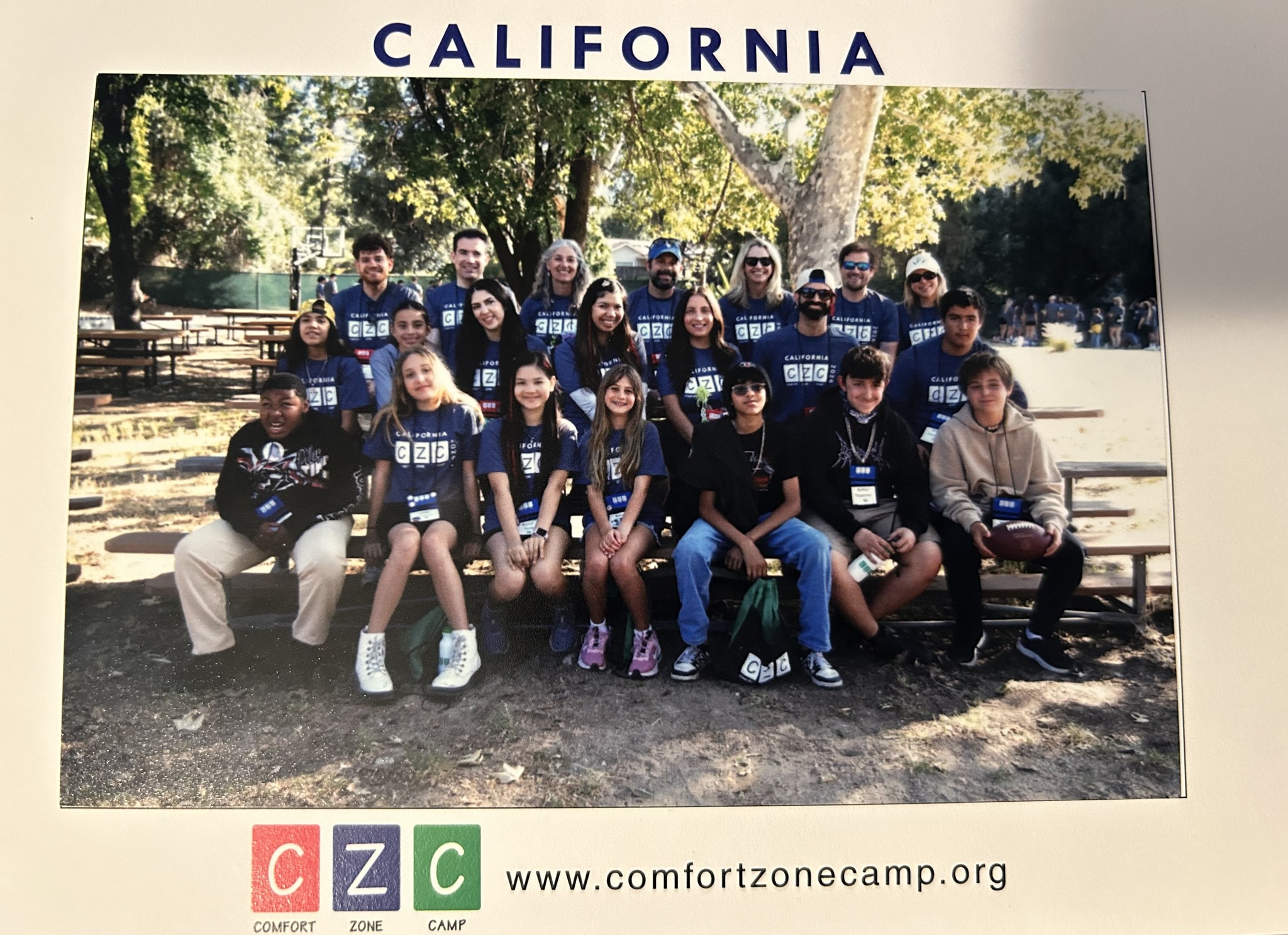
I was sitting at a lunch table this past Saturday as a volunteer at Comfort Zone SoCal when a camper, who wasn’t my little, opened up to me.
“I’m nervous about talking about my Dad’s death. It’s hard to talk about. People won’t understand. It’s different.”
“What do you mean? How is it different?”
“People won’t understand because it was suicide.”
“Well, just so you know, my Dad also died by suicide, so you’re not alone. And all of the people out here share grief for someone they loved, or they just want to help, so know you are not alone. And we got you.”
—
This was the first camp i’ve spent with several kids who shared losses like I had as a 9 year old. These kids were in 6th grade, so they were 11 years old.
It reminded me of experiences I had during those years. After my dad’s death, the years from 9 to 11 were a blur of memories and feelings. We had to move from our big house to a small one. I remember my Mom’s Mom moving in with us so my Mom could take care of her as her breast cancer progressed. I remember bullies from my old school leaving me alone and other bullies showing up in my life. I remember my Mom spreading my Dad’s ashes at our place in the Adirondacks, in the cold October rain, with my sisters, our godparents, and my sister’s school friend there. I remember my half sisters there that day, but not with us, because our families had fallen out. I remember lots of crying, by all of us, and yelling, and more crying. And hugging and making up too. At least we felt our feelings in our house. Some families never do.
Eventually I remember getting into SJS and waking up in a new 6th grade class, sitting next to a boy who became my first friend there. He had a heart condition. His Mom was a coach there. He would later pass away much too young.
That year my Grandmother passed away at our house. I remember being taken out early from class to go home. I remember being scared it was my Mom this time. I remember seeing an ambulance in front of our house. It hurt less than losing my Dad. But still, more tears. More fear. Guilt and shame were regulars. All common feelings for loved ones of people who died by suicide. Those years after my dad’s death were chaotic and I am amazed we got through it. The grief never leaves you. But it can make you stronger….
—
At that lunch at Comfort Zone, I told the camper two lesson’s i’d learned. First, from Game of Thrones. “You cannot truly be brave without being scared.” Second, something I thought of in the moment. “Trauma is like breaking a bone. It is incredibly painful, but you can heal stronger because of it.”
I know my losses have made me more resilient. While I wish people I loved had not passed, I wouldn’t change my life today. I have a wife I deeply love who deeply loves me. And when I told her my story it made her love me more and not run away. And now we have two beautiful boys who we are madly in love with. So despite my stories heaviness, I wouldn’t change it. I wear it, scars and all. I am stronger from that weight. And it has led me here.
—
At Comfort Zone, this year, the theme was a Buffalo. Buffalo are a herd animal. Their strength is together. They can run fast as one and change the grass lands they inhabit. And when storms come, they run into them. It’s the fastest way through.
We do these things at CZ called healing circles. They are where the work happens. Around the healing circles are normal camp experiences. Kids do teamwork games, trust exercises, activities, and sports. But the healing circles are where they share their stories. On occasion, there can be a bonus healing circle if kids are comfortable. It usually happens at night in the cabins before going to sleep. I was fortunate to be a part of one this year.
—
I won’t share the children’s stories from that experience, but I will share one of mine. I told them an abridged version about my friend Ross. He died by suicide after we finished college. He was a big reason why I am closer friends with many from the grade above me.
I met Ross as I was leaving SJS for boarding school. I was getting bullied. My Mom was on my case and trying to keep me on track. I had no Dad to teach me how to handle bullies, how to shave, or how to deal with feelings about life, love, or anything a 14 year old deals with. So I applied to two boarding schools to get out. One was in a small town in Pennsylvania where my older sister had gotten in for their first class of girls and where our Dad had gone after he left SJS. And one was in Northern Virginia in the D.C. area and had a 50/50 ratio of boys to girls. I chose the Virginia school. I wanted my own thing. And there were girls in sundresses there.
Before I left for EHS Va. I had been working at the local country club since I was 13. When we were members, my Dad was close friends with the pro, Dick. Dick took me on as a favor for my Mom. It was a way for me to make money and stay busy. Dick was the son of PGA Champion. He and my Dad were close because my Dad was a scratch golfer and formerly the Captain of Stanford’s golf team. My Dad’s dream was to play professionally, but his dad didn’t support it, so he became a lawyer. Later, my dad lost his eye skiing, but he was still only a few strokes over par. I remember asking Dick one day how good my dad was at golf. He replied, “He was great. And then he lost his eye, and that’s when I started winning money.” I worked at that country club every summer and sometimes after school from 13 until I was 17.
Before I left for boarding school, I met my friends Breisen and Charles in study hall. I was one of only a few 15 years they knew who had a job, and we soon became friends. I knew we needed help at the club, so I brought them on to help on the range. While other of our classmates were out there hitting balls, we were out there picking them up, cleaning the carts, and bringing up bags. We were getting paid every two weeks, so we felt good. Working with my friends that summer was the beginning of several life long friendship.
Back then, when i’d go back to boarding school, we used to actually call each other, on the phone. Regularly. We even memorized each others phone numbers in those days. Some time early into my sophomore year, I remember Breisen telling me I should meet their friend, Ross. His dad had died earlier that year.
Ross was our Chandler Bing. He was magnetic with a quick, sharp wit and an infectious laugh. He was loving and funny. He voraciously read. And he made you feel like you were the only person in the room. He and I connected because I was 6 years into my grief journey and he was just starting his, so even though I was a year younger, we had something connecting us. Often with losses, people find like people. I see this at Comfort Zone every camp. Back in the day, you had to find those people on your own. Ross was mine.
Ross was also our Matthew Perry. He became self destructive. He had mental health struggles. And he struggled with addiction as we got older. Eventually he got into more and more trouble and no one could get him through it. He couldn’t find his way out of the storm, and eventually he died from suicide too.
In late December 2008, when I was 24, I was a paralegal at Wachtell Lipton when I got the call that Ross had died. I found out at my desk and I gasped for air as I sobbed into my hands. My coworker, Danny, ran down the stairs and hugged me incredibly tight as I cried. Good people do show up when you need them some times. I’ll always remember Danny for that kindness.
I’ve only cried like that 3 times in my life. When my Dad died. When Ross died. And when my Mom died. All three of those losses were boulders dropping in the pond of my life. Their ripples were waves for me and I am different because of them.
—
In this weeks episode of the Pitt, they said the phrase “Memento Mori”, a Latin phrase meaning “remember you must die”. It is a reminder of the inevitability of death and the nature of life. It is used to focus on meaningful living, humility, and valuing the present.” This resonates because my family motto is Moriendo Vive which translates to “In dying, live”… It is interpreted as a reminder that a person’s legacy, spirit, or impact can continue to live on even after their death.”
Grief is universal. It comes for us all. Some of us earlier than others, but it comes. I have known 70 year olds who have finally lost their last parent. And I have known 60, 50, and 40 year olds who were devastated losing a parent. “By age 50, about 50% of people have lost their mother and roughly 69% have lost their father. In the U.S., among people 55–64, more than half have lost both parents. By age 40–49, around 10% have lost both parents. Discounting my blood sisters, I can only count on one hand the people around my age that I’ve know who’ve lost both their parents. Alyssa. Ben. Roy. Jack.
—
It is inevitable. We all will die. So learning about grief and honoring it is important. That’s why I believe Comfort Zone should be everywhere. I wish it were in Texas when I was 9. It would have helped me not feel alone at that time in my life.
I want to bring Comfort Zone with me to Texas when I move back. I know it is needed. Even though there are grief camps there, this one isn’t and I believe it should be everywhere. There are kids everywhere who have lost parents. Kids everywhere who have lost siblings. Kids everywhere who have lost friends. And there are adults everywhere who are struggling with grief too.
So my family will stay active in this non-profit. I will beat this drum to grow it and introduce you all to it. For yourselves, for your children, for your friends, because you should know it is out there for when or if you or your loved ones need. You don’t have to be alone.
If you want to help, please donate. Or volunteer. Or tell people who may need it. Camp is free for the kids. $1,000 pays for a kid’s whole weekend. And while some kids families can certainly afford it, some cannot. It’s mission is not about charging grieving people. So every donation matters. And volunteering matters too. The best big buddy is just an ear with arms.
“The hardest thing, is to say goodbye to someone you love.” Gorillaz – Orange County
Leave a Reply